What to expect on stage
Kraków folk costume and the krakowiak
A primer for the folk show: the krakowiak dance, the folk dress of Kraków's own region and why the Young Poland artists loved both.
Reserve your table for the show ↗Quick answer
The krakowiak is a fast, syncopated Polish folk dance in duple time from Kraków and Lesser Poland, danced by couples who circle, with a sung call from the lead dancer. Its costume, with the feathered rogatywka cap, became Poland's national dress. The folk show promises regional costumes, but the ensemble sets the programme.
The krakowiak in brief
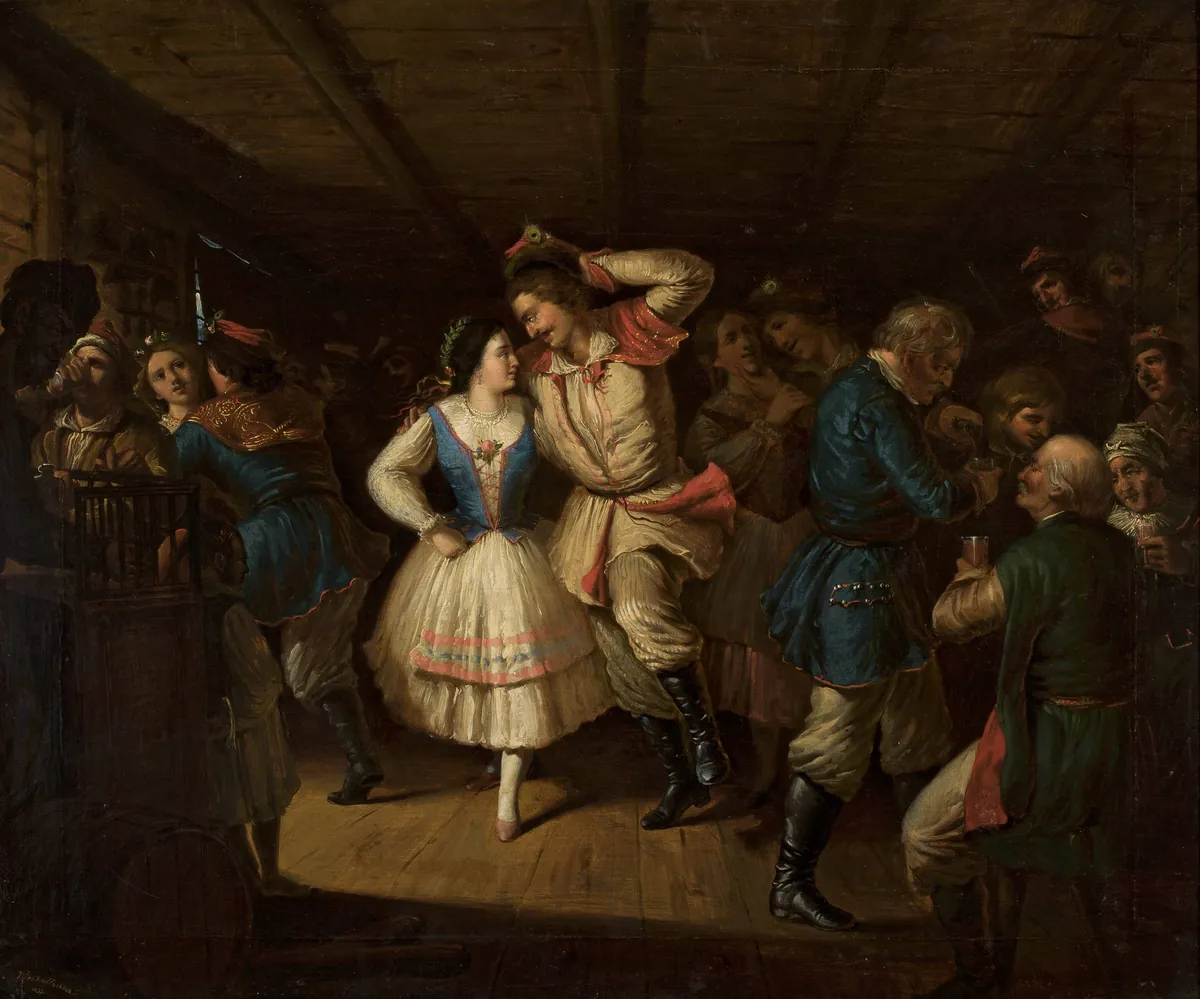
The name simply means Cracovian. Wikipedia describes the krakowiak as a fast, syncopated Polish folk dance in duple time from Kraków and Lesser Poland. Several couples dance together. The leading male dancer sings and calls out the steps, tapping his heels or dancing a few steps while he sings a known melody with new, improvised words for his partner. The band follows, and the couples move in file to form a circle, with sung verses and played verses alternating. It is a dance built around a call and an answer between the leader and the band. The painting above, from 1851, shows a krakowiak in a village inn, with onlookers close around the dancers.
A dance that travelled
The first printed krakowiak appeared in a piano album in Warsaw in 1816. The dance was popular as a ballroom dance in Vienna, where it was known as the Krakauer, and in Paris, where it was called the Cracovienne. Along with the polonaise and the mazurka it expressed Romantic sympathy for a picturesque, distant nation. Wikipedia lists it among Polish folk dances, alongside the kujawiak, and relates it to the oberek, a dance you may hear on the same stage.
The costume
The folk dress of the Cracovians, an ethnographic subgroup living around Kraków and split into Eastern Cracovians, east of the city toward Tarnów, and Western Cracovians to the west, is called the quintessential Kraków folk costume. The Cracovians speak a dialect of the Lesser Polish cluster and are mostly Roman Catholic. Wikipedia notes that the outfit became Poland's national costume, most notably through the rogatywka, a peaked hat with peacock feathers. Dancers in the show wear regional costume. Costume varies between ensembles and regions, so the Kraków feathered cap may be one of several outfits you see on the night, and the painting above is a useful reference for what an 1851 painter thought a Kraków dancer looked like.
Why artists loved it
Cracovian folk life was a stage subject long before the café: Wojciech Bogusławski's opera Krakowiacy i Górale premiered in Warsaw on 1 March 1794. Cracovian folklore inspired Polish artists again in the Young Poland period. Stanisław Wyspiański's play The Wedding, written in 1901, was inspired by the real wedding of the poet Lucjan Rydel, followed by a reception at Bronowice, now part of Kraków. Folk dress, music and dance run through the play, and Wyspiański is among the artists the Polish Wikipedia names as guests of Jama Michalika. That link is why a folk show sits comfortably in a café built for artists: the performers act out what those artists once admired.
What to expect at the show
The booking page promises regional costumes, singing and dancing, and an invitation to dance along. The organiser lists two 25-minute shows. Two 25-minute sets are short, so expect energy rather than long, slow pieces. The ensemble chooses the programme and the line-up, so no particular dance is guaranteed on a given night, but a krakowiak is a good one to look out for, since it is the dance of the city around you. If you are asked to join in, watch the couple ahead of you, follow their steps and enjoy the music, and do not worry about getting them wrong, because the room is looking at the dancers, not at you. If The Wedding interests you, Andrzej Wajda made a film of it in 1972.
Frequently asked questions
Will they dance the krakowiak?
The programme is the ensemble's to choose, so no dance is promised on a given night. The krakowiak is Kraków's own dance, so it is a good one to watch for.
Do I need to know the steps?
No. Guests are invited to join in, and the dancers lead. You can also stay seated and watch.
What is the feathered hat?
The rogatywka, a peaked hat with peacock feathers that is part of the Kraków folk costume and became a symbol of Polish national dress, according to Wikipedia.
Sources